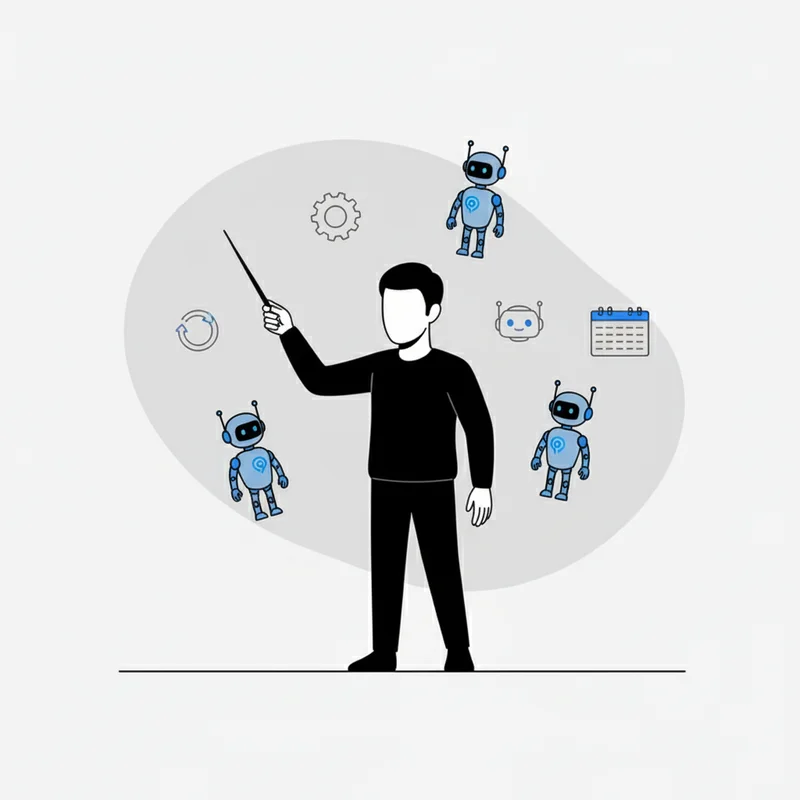
Key Takeaways: AI Agents for Business
AI agents for business represent a paradigm shift from passive AI tools to active, autonomous entities capable of performing complex tasks and making decisions with minimal human oversight. This technology is revolutionizing business process automation, enabling companies to delegate routine and even strategic tasks to intelligent systems, significantly boosting efficiency and innovation.
- AI agents are autonomous programs that can perceive their environment, make decisions, and take actions to achieve specific goals.
- They drive full business process automation by handling repetitive tasks, data analysis, customer interactions, and more.
- AI task delegation frees human employees to focus on higher-value, strategic initiatives, fostering innovation.
- Multi-agent systems allow specialized AI agents to collaborate, tackling complex business challenges more effectively.
- Small businesses can leverage AI for small business to scale operations, reduce costs, and compete with larger enterprises.
What are AI Agents for Business?
AI agents for business are advanced artificial intelligence programs designed to operate autonomously, executing tasks and making decisions to achieve predefined business objectives. Unlike traditional AI tools that merely assist, these agents are proactive, capable of understanding context, learning from interactions, and adapting their strategies. This makes them indispensable for deep business process automation, moving beyond simple task execution to intelligent task delegation.
For instance, an AI agent might manage an entire customer support workflow, from initial query routing to providing personalized solutions and escalating complex issues to human agents when necessary. This level of autonomy is transforming how companies approach operational efficiency, allowing for significant improvements in speed, accuracy, and resource allocation. Illia Hryhor emphasizes that the true power of AI agents lies in their ability to integrate seamlessly into existing workflows, creating a cohesive and highly efficient automated ecosystem.
"The transition from passive AI assistants to active, autonomous AI agents is one of the most significant shifts in business technology today. These agents are not just tools; they are virtual team members capable of driving entire processes." — Illia Hryhor
How do AI Agents Automate Business Processes?
AI agents automate business processes by taking over repetitive, rule-based, and even complex decision-making tasks. They can interact with various systems, analyze data, communicate with other agents or humans, and execute actions without constant human intervention. This comprehensive approach to business process automation AI leads to streamlined operations, reduced errors, and faster execution times across departments.
Consider a marketing department. An AI agent could analyze market trends, generate personalized content for different customer segments, schedule social media posts, and even monitor campaign performance, adjusting strategies in real-time. This level of AI task delegation allows human marketers to focus on creative strategy and high-level campaign design, rather than manual execution. According to a McKinsey report, 72% of companies already use AI in at least one business function, with 64% expecting increased productivity from AI.
What are the Benefits of AI Task Delegation?
The benefits of AI task delegation are multifaceted, offering businesses a competitive edge in today's fast-paced market. By delegating tasks to AI agents, companies can achieve remarkable improvements in efficiency, cost savings, and innovation. This strategic move frees up human capital, allowing employees to engage in more creative and strategic endeavors that directly contribute to growth.
- Increased Efficiency: AI agents operate 24/7 without fatigue, processing vast amounts of data and executing tasks far quicker than humans. For example, Timeweb Cloud implemented an AI assistant for tech support in April 2026, achieving a 96.3% response quality and reducing engineer workload by 22%.
- Cost Reduction: Automating tasks with AI agents reduces the need for extensive manual labor, leading to significant savings on operational costs and human resource allocation.
- Improved Accuracy: AI agents minimize human error, ensuring higher accuracy in data processing, calculations, and repetitive tasks.
- Scalability: Businesses can easily scale their operations by deploying more AI agents as demand grows, without the overhead of hiring and training new staff.
- Enhanced Customer Experience: AI agents can provide instant, personalized support and services, leading to higher customer satisfaction.
Illia Hryhor notes that embracing AI task delegation is not just about automation; it's about intelligent resource allocation and empowering your workforce to achieve more. "The goal is to augment human capabilities, not replace them entirely."
How Multi-Agent Systems Enhance Business Automation?
Multi-agent systems involve multiple AI agents working collaboratively to achieve a common goal or a set of interconnected goals. Each agent in a multi-agent system can specialize in a particular function, such as data analysis, communication, or task execution, and then coordinate with other agents to complete complex workflows. This approach significantly enhances business process automation AI, especially for intricate operations that require diverse capabilities.
For instance, in a supply chain, one AI agent might monitor inventory levels, another could manage supplier communications, and a third might optimize logistics routes. These agents would communicate and share information in real-time, ensuring a highly efficient and responsive supply chain. Uklon, for example, transitioned to a multi-agent architecture to overcome limitations in context volume and "hallucinations" in their AI systems. This collaborative model is a powerful form of AI task delegation, enabling businesses to tackle challenges that single AI agents or human teams might struggle with.
// Example of a conceptual multi-agent system interaction
Agent A (Inventory Monitor) -> Detects low stock for Product X Agent A -> Notifies Agent B (Supplier Manager) Agent B -> Generates purchase order for Product X with preferred supplier Agent B -> Sends order to Supplier System Agent B -> Notifies Agent C (Logistics Optimizer) for inbound shipment planning Agent C -> Updates delivery schedule and warehouse capacity
This coordinated effort exemplifies how multi-agent systems can create a robust and adaptable automation framework. For more on advanced AI integration, explore articles like AI Agents and Multi-Agent Systems: Full Automation 2026.
Can AI Agents Benefit Small Businesses?
Absolutely. AI for small business offers transformative potential, allowing them to punch above their weight, compete with larger enterprises, and achieve growth that was previously unattainable. Small businesses often grapple with limited resources and tight budgets, making efficient business process automation AI critical. AI agents provide an affordable and scalable solution to these challenges, enabling them to automate key functions without significant upfront investment in human capital.
Consider a small e-commerce store. An AI agent could manage customer inquiries, process orders, track shipments, and even identify cross-selling opportunities. This level of AI task delegation frees the small business owner and their limited staff to focus on product development, marketing strategy, and building customer relationships. According to a Statista report, the virtual assistant market is expected to reach $14.10 billion by 2030, growing at a CAGR of 24.3%, indicating significant adoption across businesses of all sizes.
Illia Hryhor frequently advises small business owners on leveraging AI. "For small businesses, AI agents are not a luxury, but a necessity to streamline operations, reduce overhead, and scale effectively in a competitive landscape." For further insights on cost-effective AI solutions, you might find Cheap AI for Business: How to Save on LLM API particularly useful.
Real-World Cases of AI Agents in Action
The impact of AI agents for business is already being seen across various industries, demonstrating tangible benefits and significant returns on investment. These real-world applications highlight the power of business process automation AI and intelligent AI task delegation.
One notable example comes from "Передові Платіжні Рішення" (Advanced Payment Solutions) which, in April 2026, implemented an AI-powered "sales prompter." This system assists new sales representatives, enabling over 70% of them to successfully overcome complex objections during calls. This direct application of AI agents in sales training and real-time support significantly boosts productivity and accelerates the onboarding process for new hires.
Another compelling case is "ВкусВилл," a retail chain, which in April 2026 utilized computer vision (a form of AI) to reduce fruit and vegetable spoilage by 14%. While not a typical "agent," this illustrates how AI can autonomously monitor and make decisions (e.g., reorder, mark down) based on visual data, impacting inventory management and reducing waste. Such applications underscore the diverse ways AI agents can be deployed for substantial business improvements.
"We're seeing a clear trend where businesses that embrace AI agents are not just optimizing, but fundamentally transforming their operations, achieving productivity gains of 30% or more." — Illia Hryhor
These examples show that AI agents for business are not just theoretical concepts but practical solutions delivering measurable results today. The focus on usage-based billing models by companies like Anthropic and GitHub Copilot, as noted in recent trends, further encourages businesses to optimize their AI usage, making these solutions even more cost-effective when implemented strategically. For insights on managing AI costs, check out SaaS Pricing 2026: Pay for Results, Not Seats.
Challenges and Solutions in Implementing AI Agents
Implementing AI agents for business is not without its challenges, particularly for companies with legacy IT infrastructure or those new to advanced automation. However, understanding these hurdles and having clear solutions can pave the way for successful business process automation AI and effective AI task delegation.
| Challenge | Description | Solution |
|---|---|---|
| Data Maturity | Lack of high-quality, structured data for AI training. | Invest in data cleansing, standardization, and robust data governance strategies. Implement data pipelines for continuous data enrichment. |
| Integration with Legacy Systems | Difficulty connecting modern AI agents with older, proprietary software. | Utilize API integration platforms like n8n or Make.com, or develop custom connectors. Focus on CRM API & Webhooks Integration to bridge systems. |
| AI "Hallucinations" | AI generating incorrect or nonsensical information. | Implement AI guardrails, use multi-agent architectures for cross-verification, and employ human-in-the-loop processes for critical tasks. See AI Guardrails Zapier: Business AI Automation Security for more. |
| Security and Privacy | Protecting sensitive business and customer data handled by AI agents. | Deploy AI solutions locally where possible (like Vodafone Ukraine), develop proprietary closed models (like monobank), and adhere to strict data security protocols and compliance standards. |
| Cost Management | Controlling expenses with usage-based AI service pricing. | Optimize AI queries, monitor token consumption, and explore self-hosted or open-source solutions where feasible. |
Ukrainian companies like "Епіцентр," "Vodafone Україна," and "МХП Агрохолдинг" have faced these integration issues, highlighting the need for strategic planning and investment in IT infrastructure modernization. Illia Hryhor consistently advises clients to start with pilot projects, gather data, and iterate, building a robust foundation for AI integration.
The Future of AI Agents and Full Automation
The trajectory of AI agents for business points towards an increasingly autonomous and integrated future. We are moving beyond simple automation to hyperautomation, where AI agents, powered by advanced large language models (LLMs) and sophisticated decision-making capabilities, will manage entire operational ecosystems. This vision of full business process automation and extensive AI task delegation is rapidly becoming a reality.
Major tech companies are heavily investing in AI infrastructure, with plans to spend nearly $1 trillion by the end of 2026, signaling a massive push toward more powerful and pervasive AI. Google is actively developing its AI agent, "Remy," designed to execute complex tasks and integrate seamlessly with other Google services. This trend towards personalized and deeply integrated AI models, adapting to user communication styles and professional contexts, will further refine the capabilities of AI agents.
The development of a national Ukrainian LLM, "Сяйво," is also a significant step, providing a secure and locally trained foundation for AI applications within the country. This model, expected in beta by spring 2026, will be crucial for sensitive sectors like defense, government, and finance, ensuring data sovereignty and tailored performance. Illia Hryhor believes that such initiatives will empower local businesses to innovate with AI confidently. More details can be found in National LLM Syaivo: Opportunities and Prospects for Business.
The future will see AI agents not just assisting, but actively leading and optimizing workflows, making intelligent decisions that drive business growth and efficiency to unprecedented levels. This evolution underscores the importance of businesses preparing for and embracing these advanced forms of AI task delegation now.
Frequently Asked Questions
What is an AI agent for business?
An AI agent for business is an autonomous software program designed to perform tasks, make decisions, and interact with systems and users to achieve specific business objectives with minimal human intervention. It goes beyond simple automation, demonstrating proactive behavior and learning capabilities.
How can AI agents increase business efficiency?
AI agents increase business efficiency by automating repetitive tasks, processing data at high speeds, reducing human error, and enabling faster decision-making. This allows human employees to focus on strategic, creative, and complex problem-solving, leading to overall productivity gains of 30% or more, as seen in many implementations.
What is AI task delegation?
AI task delegation is the process of assigning specific business functions, processes, or responsibilities to AI agents. This can range from customer service inquiries and data entry to complex analytical tasks, freeing up human resources for higher-value activities and strategic initiatives.
Are AI agents suitable for small businesses?
Yes, AI agents are highly suitable for small businesses. They provide cost-effective solutions for automating operations, managing customer interactions, and optimizing workflows, allowing small businesses to scale efficiently and compete effectively with larger organizations without significant overheads.
What are multi-agent systems in AI?
Multi-agent systems are collections of two or more AI agents that collaborate and communicate to achieve shared or complementary goals. These systems are particularly effective for complex business processes that require diverse capabilities and coordinated efforts, such as supply chain management or advanced data analysis.
What are the main challenges when implementing AI agents?
Key challenges in implementing AI agents include ensuring data quality and maturity, integrating with existing legacy IT systems, mitigating AI "hallucinations" (inaccurate outputs), ensuring robust data security and privacy, and managing the evolving costs associated with usage-based AI services.
Embracing AI agents for business is no longer an option but a strategic imperative for companies aiming for full automation and optimal task delegation. By leveraging these intelligent systems, businesses can unlock unprecedented levels of efficiency, innovation, and growth. If you're ready to explore how AI agents can transform your operations, don't hesitate to get in touch with Illia Hryhor for expert guidance and tailored solutions.